Knowledge

Resources.

Catalogues, brochures, white papers and the technical record — hosted here. Live system documentation stays with the engineers at docs.wittra.io.

Download

Brochures & catalogues.

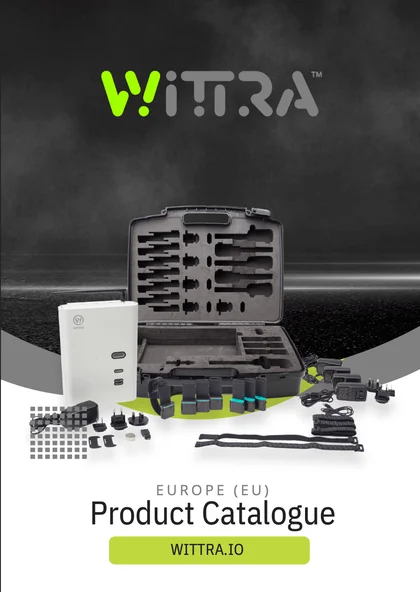
Product Catalogue — EU

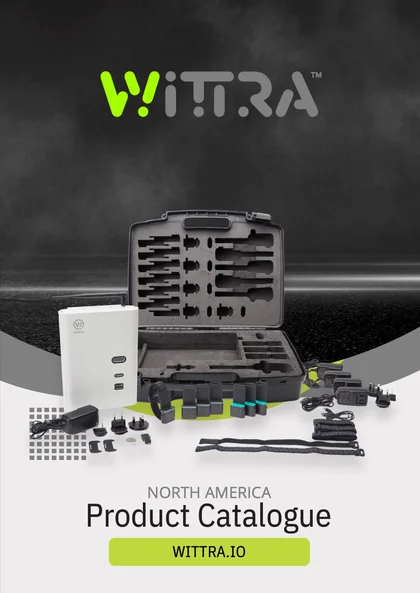
Product Catalogue — North America

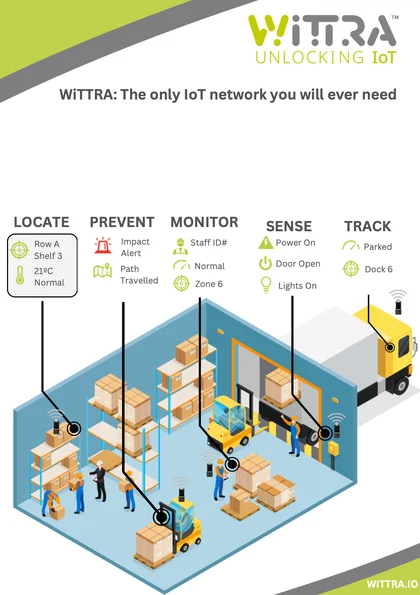
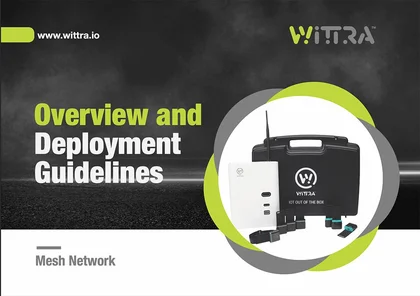
Wittra Intro Brochure

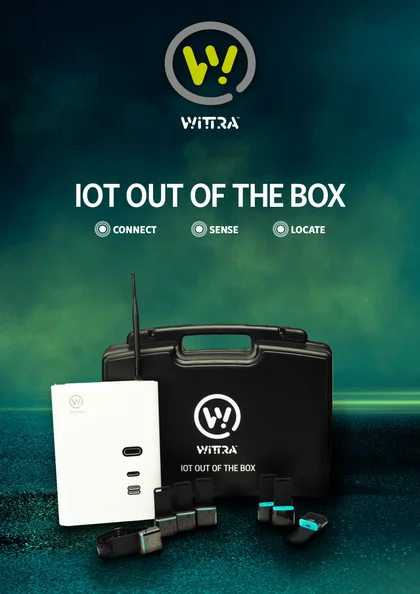
Wittra Brochure

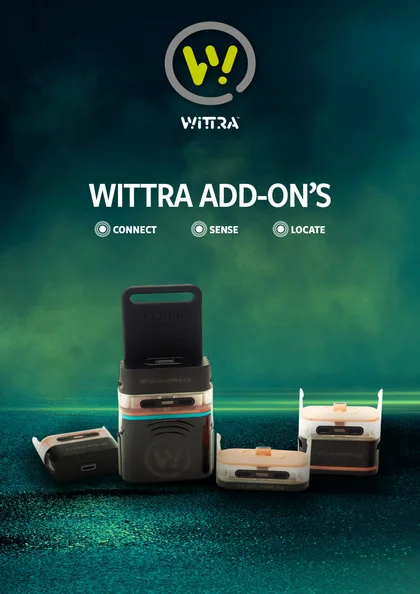
Add-Ons

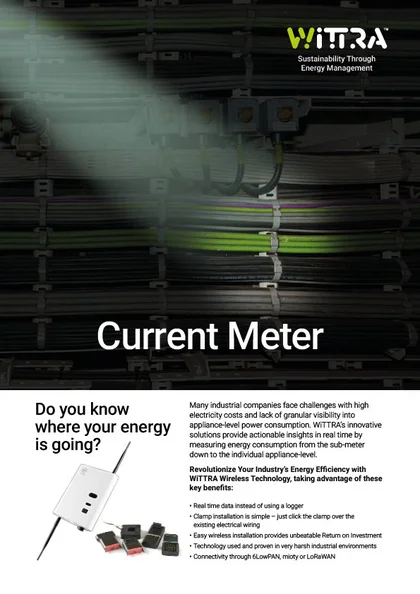
Current Meter

6LoWPAN + LoRa LPWAN

6LoWPAN + mioty

Wittra Booklet — True Mesh

Certificate — SBcert (2024–2027)

Deep reading

White papers.

Positioning Technology

Hybrid Positioning Network Technology

Revolutionising Asset Tracking

A Systems Integrator's Guide to IoT

Smart IoT Solutions for Sustainability

Answers

FAQ.

Product introduction

What data does the Wittra Sense360 provide?
  • Out of the box, the standard Sense360 tag includes: accelerometer (moving/stationary), magnetometer (magnetic orientation/compass direction), gyroscope (rotation — optional, contact Wittra), location (radio signal strength to nearest Mesh Routers plus time-of-flight trilateration, configurable) and internal tag temperature (approximately mirrors surrounding air temperature with some lag, as the tag is sealed).
  • An external click-on sensor adds ambient light level, external air temperature, humidity and air pressure.
  • Via the data streamed in the cloud API, customers can derive tilt, fall, shock and other movement-related metrics alongside environmental and location measurements.
Do the sensors provide GPS coordinates?
  • The Sense360 does not contain an independent GPS module. The cloud portal shows its position on a map (with a user-defined floorplan or site plan) within the network coverage area, and coordinates are available from the cloud API (latitude/longitude).
  • GPS is not a competitor to Wittra: GPS offers outdoor positioning only, whereas Wittra covers outdoor and indoor positioning plus a large range of sensor data.
  • GPS does not work reliably in buildings, areas of high interference or indoor/outdoor transitions — the Wittra solution covers all environments in one technology deployment.
What does the software look like and how does it interact with the system?
  • The Wittra management platform lets users securely onboard and manage network and sensor devices, visualise position and sensor data, troubleshoot the system and set up APIs for data export.
  • Alerts and notifications are customizable: interval-based (by time) or event-based (by defined event, e.g. how long something is moving).
  • API integrations allow data export — push data to a third-party URL, or REST API queries. Console: console.wittra.se.
How easy is the system to set up?
  • Very easy — most initial setups are up and running within a few hours, and easily expanded within a few days.
  • Extensive instructions and videos are available in the Wittra portal and at docs.wittra.io.
What is the reliability of the system?
  • This is the strength of the Wittra technology: properly installed, it is extremely reliable. The radio mesh continuously looks for the best signal path from Sense360 to gateway, overcoming interference, radio black spots and dynamically changing environments.
  • Reliability comes down to network planning and installation: use the portal's setup tool to check the quality of each radio link, give Mesh Routers a permanent power source, and give the gateway reliable mains power and a solid Ethernet connection.

Technology

What is Wittra's core technology?
  • 6LoWPAN (IPv6 over Low-Power Wireless Personal Area Networks) — a sub-GHz radio mesh chosen for long signal hops, low power consumption and good propagation through building structures.
  • Mesh Routers form a self-forming, self-healing network: if one router fails, the network reroutes — eliminating lost data packets.
  • Frequency hopping provides robustness against interference: each device listens before communicating and finds a clear channel — a "polite" approach to shared bands.
  • Future-proof architecture with over-the-air firmware updates.
What is the range of a Wittra network?
  • Approximately 500 m radius for the gateway and 300 m per Mesh Router in open air with line of sight. Adding routers and gateways extends range significantly; install Mesh Routers at least 2 m above ground.
  • Indoors, achievable distance depends on walls and floors in the path; large metallic objects block the signal and should be considered during installation.
  • For positioning, space Mesh Routers every 30–100 m horizontally in a grid; vertically, expect reliable connection through 2 floors of reinforced concrete.
  • Sub-GHz positioning is 2D (per floor level); for 3D positioning, use the UWB click-on on Mesh Routers and Sense360 tags.
Does the position of the Mesh Router matter?
  • Yes — especially for asset tracking. Ideally, install Mesh Routers around the boundaries of the positioning zone; the Sense360 needs a minimum of three routers for accurate results.
  • If routers end up more than ~30 m apart indoors, add one or more routers toward the middle of the zone.
How accurate is the positioning?
  • Wittra delivers positioning accuracy of less than 1 metre depending on device, system configuration and site conditions: sub-GHz mesh alone gives 1–7 m; the UWB click-on achieves 0.5 m.
  • A Sense360 must communicate with at least three Mesh Routers / Positioning Beacons for high-accuracy positioning — proper site planning and placement matter.
How is positioning calculated?
  • RSSI (received signal strength) from the tag to three or more Mesh Routers.
  • ToF (time-of-flight) — a significant step up: measuring the radio signal's travel time from tag to router, allowing a less dense network (greater distance between routers).
Can you track mobile assets?
  • Yes — mobile assets are positioned within site boundaries, with location updates down to 20-second intervals depending on how many mobile tags are in the network.
  • Frequent updates affect battery run-time (recharge via micro-USB); a plug-in external battery pack triples on-board capacity.
Can you track an asset that has left the network area?
  • Wider-area coverage via mioty, and GPS modules that offload position data through the mioty network (available through third-party vendors — see the Mioty Alliance), are the roadmap options for off-site tracking.
  • Each site requires its own gateways and routers, but a tag entering a new site with a valid PAN ID starts sending data automatically — a "roaming"-like capability.
Gateway power, IP rating and packaging?
  • The gateway uses a 12 V DC supply (included), drawing about 1 A depending on workload. Mesh Routers charge at 5 V / 100 mA and average 8 mA in normal operation.
  • The gateway (IP51) can be fitted with a waterproof antenna connector as a factory option. External antenna cables cannot be offered in North America due to FCC rules on high-gain antennas.

Operational notes

What is the level of support available?
  • First-level sales, marketing and technical support on CET (9:00–17:00); product and technical escalations answered within ~24 hours from the European HQ.
  • End customers typically work with a system integrator or platform provider for primary support; Wittra remains responsible for all aspects of its hardware and APIs, supporting SIs and platform providers.
  • Expanded technical support plans are available based on deployment size.
Are products certified for North America?
  • Yes — most products are FCC certified for operation within North America (USA and Canada).

Security

System Security
Statement.

Wittra offers the typical security any web solution offers. There are two ways to access the data: through the database directly, or through the API. The database is a standard NoSQL solution (Firebase) that requires authentication and is set up so that only accounts within the Wittra Google Cloud project have access. The API is secured so that you only have access to data within your own organization, with the possibility for the creator of an organization to invite others.

Sensor data is encrypted and authenticated with DTLS, ensuring host-to-host security between device and gateway — no wireless device can eavesdrop on data or impersonate a Wittra device without first breaking state-of-the-art AES-CCM encryption. The gateway relays data to the cloud over a TLS connection with a keypair managed by the built-in TPM chip (Trusted Platform Module) — security secrets never exist in the gateway's memory; they are kept inside the tamper-resistant TPM. This allows the backend to reliably authenticate Wittra gateways and protect the confidentiality of all sensor data.

Questions about the System Security Statement: info@wittra.io · Platform security model: docs.wittra.io → Security

The moat

Patented
technology.

16 patent families, in excess of 80 patents and applications. Through ingenuity, persistence and a passion for solving the impossible, Wittra continues to redefine positioning technology previously considered unimaginable.

The Wittra approach: positioning based on sub-GHz, license-free SRD/ISM bands — achieving signal transmission range outdoors, underground and indoors in a single technology deployment, with reliable positioning of ±5 metres 85% of the time. The patented technology is used throughout the Wittra product range and can be licensed for OEM use in third-party devices.

The tangible outcome is a game-changer for deployment economics: rapid proof-of-value installations, quoted to your needs, against a standard drawn-out proof of concept — and a full-site total cost of ownership 70–80% below competing technologies that provide both sensor and positioning data. A key reason is the low-density "True Mesh" network, which typically requires only 10% of the anchor points of a typical Bluetooth installation — with similar savings against WiFi, Zigbee and UWB-only systems. Key to accuracy in this low-density mesh is Wittra's multi-patented time-of-flight technology on sub-GHz narrowband channels.

Patents include

Enhanced Time of Arrival Positioning System Single Node Location System and Method Enhanced Positioning Methods Suitable for Low Frequencies Method for Determining Distance Between Two Nodes Secondary Node, Central Node and Methods for Positioning in Wireless Networks

Source: Wittra patented-technology record. Licensing enquiries: info@wittra.io